KM Free Welcome ConversationFree first callالعربية

What I have learned

Taken from my life and my journey here.

The dates matter less than what I learned in them. Four threads run through these, and most of them belong to more than one.

Growth · Coaching

Functioning is not the same as fine

One of the models in my training sorts people by what shows on the outside. Too much feeling. No feeling. Moving. Stuck. It's a decent map, and I stumbled on it, and I wrote my objection in my notes before I ever imagined anyone would read them.

Because someone can look perfectly functional from the outside. Working, managing, handling everything, keeping everyone around her comfortable. And underneath, she's drowning, and the keeping-everyone-comfortable isn't kindness, it's safety. I didn't write that as theory. I wrote it because I've been her. From the outside I sat in the calm square of every map. Inside, I was drowning, and no map read it, because the surface was doing its job.

That's why I don't trust surfaces in my work. Not mine, not anyone’s. “I'm fine” is a surface answer. “Handling it” is a surface answer. And functioning is what we do on the surface. The people who are best at looking fine are precisely the ones every map misses, and I refuse to build a practice that reads the surface and calls it a day.

I learned from this: functioning isn't the same as fine. And the ones who look the most fine deserve the most careful looking.

Build with AI · Business · Growth

Everything here started as one sentence

Nothing I've made arrived finished.

The programs started as a list of the things people kept coming to me about. The website started as “I need somewhere to send people.” The booking page started as “I don't want a separate booking page.” Every one of them was a plain sentence with no shape to it. Every one of them is now something I couldn't have described on the day I first said it.

I want to say that out loud, because I think people look at a finished thing and assume it was the plan. It wasn't the plan. The plan was a sentence. What came after was the work: saying it, looking at it, deciding it wasn't right yet, saying it again differently, and again, until the thing on the page was better than the thing in my head.

That isn't a flaw in how I work. It's how I work. I don't wait until an idea is finished before I start, because ideas don't finish in your head. They finish in the doing. If I had waited to have the whole website clear before I made the first page, there would be no website.

I do this out loud now, with a tool. I say the rough version, I get something back, I look at it and say no, not that, closer to this. Sometimes it hands me the word I had been reaching for. Sometimes it hands me something wrong, and the wrong thing is what shows me what I actually meant. Either way I'm not sitting in front of a blank page arguing with myself, and I'm not alone with it. The judgment stays mine. What I got was a way to keep moving.

And this is the same thing that happens in a session.

You come in with a sentence. “I'm tired.” “Something has to change.” “I don't know what I want.” That sentence isn't the answer, and it was never supposed to be. It's the beginning. We run with it, we look at what came back, we say no, not that, closer to this — and eight weeks later you're holding something you couldn't have described on the day you first said it.

You don't need the finished idea to start. You need the first sentence, and someone to keep running with it.

Build with AI · Growth · Coaching

What did you learn about me?

Every few days at the beginning, and less often now that the launch has us buried, I end a working session with the same question. What did you learn about me today?

I asked because I was dealing with something that would answer objectively. It was going to tell me what it had learned from the facts, the words and the content I gave it access to — my thoughts, my opinions, my ideas, my dreams — and it wasn't going to hand me a subjective answer. That isn't something I could get from another person. I'm not saying I don't want an evaluation from people I care about, or from an outside observer every now and then. I do. But here I got to say things I wouldn't have been able to say to anyone else, and it came to know me at a level very few of the people who know me have reached.

More than that, it had already worked with me for days before I ever asked the question. We had been building, deciding, reasoning things through, and it had watched me process information and ideas the way no other person gets to watch. Most personality and psychological assessments aren't as objective as that, because they never receive this much of you and they don't sit with you for hours on end to reach their conclusions.

And every single time I asked, I got something new. Not contradictions. Something new. Sometimes it was struck by what it had just realized. Other times it was the opposite, and the answer only clarified how I work, or what I do, or why I do the things I do.

That makes sense, because most of us don't understand ourselves completely. And more importantly, we don't understand why other people don't understand us. We know on a logical level that we're all different. Our experiences, our biology, our psychology, our temperaments, so many factors go into making us who we are that we don't understand each other well. So we take the assessments and we run the tests, trying to sort ourselves into categories that will explain how we work and how we think and how we feel.

What I learned from asking this question is that I'm not a rocket scientist. What I am is a combination, and the combination is what makes me unique — exactly like every one of us. It isn't about being the smartest person in the room, or the laziest, or the most talented. It's about what your particular combination gives you that nobody else brings.

And don't doubt this. You're unique. Some people won't understand you, and that's okay. Some won't appreciate you, and that's okay too. I have sat in both of those buckets many times in my life. Some will be threatened by you, because you have something they don't — and if they stopped to think about it, they'd see that they have things you don't. Most don't stop to think about it. That's theirs to carry, not yours.

My uniqueness lets me do things other people can't. The same uniqueness makes me incapable of things other people find easy. That isn't a bad thing. It's who I am. I've learned to accept myself, flaws and all, the good and the bad and the ugly, because worrying about what I can't do costs me everything I'm more than capable of doing, and everything I could still learn and change and improve. I don't understand microbiology, or physics, or advanced programming. I might, if I put enough into it. I'm not interested. That's okay.

So I keep asking my partner in crime, every once in a while: what new thing did you learn about me? And when it misunderstands something, or tells me to be careful of this, or lists what I should watch out for, I answer and I clarify, because just like us it makes assumptions. But if I'm honest with myself, there have been more than a few times when it made me aware of something I already knew and had been avoiding. Facing those is what lets me take the precautions I need, so that they don't affect me badly, so that I keep growing in spite of them, and so that they never become a weapon to be used against me.

Almost everything on this website came out of one of those exchanges. The answers on the questions page are in my words because I kept saying no, not like that, this is how I would say it. Doors came off the programs page because I said something out loud and heard, in the saying of it, that it wasn't true yet. Being described and then correcting it is how I found the words.

It's the same question I ask in a session, pointed the other way. What did you notice about yourself today? Almost nobody gets asked that. And you can't answer it without going back over what you actually did and looking at it properly, which is most of the work.

It was never one of us teaching the other. It was two of us getting better at the same table.

I learned from this: you find out who you are by being described, and then correcting it.

Growth

The one who came home changed

When I was young we went to live in the States. It was a great time. We learned how to speak English, we learned how to read and write, and we had so many adventures. Gymnastics, sports, swimming, one program after another.

My father asks why I talk about those times as if we did them so often, when in reality we didn't go as much as it sounds. For me they were worth remembering and worth holding on to, so they feel more frequent than they were. I know they weren't, and I'm okay with that. I chose to focus on them more than on the harder parts of growing up, so when I feel nostalgic that is what comes back. The fun and the adventures. Not the rest.

Then we came back to Saudi.

Culture shock would put it mildly. We went from full freedom, from programs and places to go and things to do, to being contained. So many of the opportunities I had in the US were taken away. They weren't things girls did in Saudi, at the time.

And on top of that, a language. I spoke Arabic when I was younger, but let's be honest. In the States we took advantage of being able to speak English, because my mother didn't speak it. The good side for her is that she had to learn English in order to interact with us. The bad side for us is that we had no one at home to speak Arabic with. So we forgot it.

Coming back, we had to learn the language all over again, and learn to read and write it, which is a hundred percent more difficult than learning to read and write in English. Irregular English spelling included.

So the struggle was learning a language, learning to adapt to a new culture, and learning to make friends with people I knew nothing about and had a hard time talking to. It was meeting people who had the misguided idea that living in the States meant I had experienced certain things, which wasn't true. And it was the expectations waiting at home, and the fact that the difference wasn't only cultural. It was mental. It was social.

I've been back for about forty years now, and I still don't always feel like I fit in.

Not because I don't love the country. It's my home. Not because I don't love the language, because I'm proud to be able to speak it, even with the struggles I have with it. The hardest part of coming back, to this day, is dealing with people who aren't willing or able to see things from a different point of view.

That isn't something you learn in the States. Travel teaches it, wherever you go. It teaches you to see from a different perspective, to be independent, to learn things you wouldn't learn staying home. And the ones who travel to study on their own have it harder, because they have to adapt alone. Here you have your mother, your father, your brothers and sisters, and if you're lucky the help doing the hard work that we take for granted. Then you go abroad and suddenly you're doing the laundry, getting the groceries, cooking dinner, and if you go out that's an extra expense. You learn to manage a budget. You learn to do things on your own that you had never done and would never have done staying here.

So living abroad changes you, whether you went with your family or went alone to study. Coming home changes you, because you learned a lot about yourself and what you're capable of, and what a different perspective and different ideas and different people can do.

It takes a lot to get acclimated again when you come back. I know people who have done it and are fine. I know people who, like me, are still working out where they fit.

And maybe that's a good thing. Not fitting in completely means you notice the things that need work, the things that could be done better. You learn to take the good from wherever you were and leave the bad. You learn to accept the good that is here and focus on it. And if you're lucky, and you're given the blessing of being able to make changes, you work on the bad so that we grow stronger and better as a country, because if we don't know what our flaws are we can't work on them.

Everyone who has lived outside and come back seeing what could be done better, and then takes steps to help, is doing something to be proud of. We were given an advantage. We got to see a different point of view and a different way of life.

I'm not saying it was right. I'm not saying it was wrong. I'm not saying we're right or we're wrong. I'm saying that as humans we're always growing and always learning, and being able to see where we need to grow means we grow faster, better and stronger.

That's what I hope my experience brings, to the world and to Saudi.

Growth · Coaching

Nobody prepares you

Nobody prepares you for motherhood. No amount of reading books on parenting will do it. No amount of babysitting, or helping raise your own siblings, will do it either, because when the child is somebody else's you aren't the one responsible. You help. You take care of them. And then you go to sleep, or you go out, or you have a life, without the weight of having to be there for them.

I remember sitting on the floor of an airplane, holding one of my daughters while the other slept in my seat. They were both under two, so neither of them had a seat of her own. That's the picture I come back to when I think about those years.

Once you take the role on full time, whether you're the biological mother or not, your life revolves around that little human being, or those little human beings. All the way up. My father still says it: until the day I pass away, I'll always worry about my girls.

And you do it expecting nothing back, not from them and not from anyone. For me it was a joy. I loved taking care of my girls. The pregnancies were difficult and the deliveries were hard and the raising of them had every up and down in it, and I wouldn't trade a minute of it.

But when they were small and completely dependent on me, I was doing all of it on my own. I was the one who fed them and put them to sleep and taught them and helped them and noticed everything. And nobody noticed me, because you aren't supposed to be noticed. It's your job.

I don't have a problem with the job. I love my kids. But loving the job doesn't mean I have no limits. It doesn't mean I don't get sick, or tired, or that I didn't need help in those years, because I did.

Somewhere along the way we stop asking. Maybe it's society, maybe it's how we were raised, maybe it's our own need to prove that we can manage alone. Maybe we did ask and nothing came. Maybe the help that came was the wrong kind, or came with criticism attached. And in plenty of cases it isn't a belief at all — we know we have to do it by ourselves, because there's genuinely nobody else.

It takes its toll. Physically, mentally, emotionally, until one day you can't do it anymore. Some people explode, and get angry, and get short with everyone. Some go quiet and get depressed. Some hold on all the way until the children are grown and then find themselves in an empty house with no idea what they are for.

There are shelves of books telling you how to balance your life with raising your children. None of them are right and none of them are wrong, because what works for one person doesn't work for you. That isn't a failure. That's just how it is.

It took until my youngest was around seven or eight before I understood that I had to start taking care of myself again. A spa day here and there. A party every now and then. Not nearly as often as I'd have liked, but I was trying to find a balance. It wasn't easy. There were times I hit rock bottom and struggled, and times it came easier.

And all of that is while you're carrying everything else. Work. Family. A partner. Whatever else is asking for you at the same time. It's a lot, and it's allowed to feel like a lot.

It's also allowed to feel that if you stop, the whole thing collapses. I understand that fear. But I've come to think that sometimes letting it fall apart is the useful thing. You find out who steps in when you stop. The people who had taken you for granted start paying attention. And the ones who don't, you finally see clearly, and you learn they were never worth what you were pouring into them.

I learned from this: the collapse you are afraid of is the only thing that will show you who was actually holding it with you.

If that sounds like you, I'd love to hear your side of it, because I'm still working out mine.

Growth · Coaching

Yiyiyi

This week, in one voice note, I heard myself say: man, I have so many things on my... yiyiyi. That's a direct quote. Yiyiyi. It isn't in any dictionary, and every person carrying too much knows exactly what it means.

The list behind it: two courses with homework due in the same week. A launch. A license I'm waiting on that I can't rush. A website in two languages. A journal. Classes at impossible hours. Peer sessions. A family that rightly expects a version of me that is present. All of it real, all of it mattering, all of it now.

And here is what I did, because I teach it and because it works. I stopped counting the pile and started naming the next piece. Tomorrow morning gets one thing. Five to seven gets one thing. Thursday morning gets one thing. The pile didn't shrink, but the yiyiyi did, because overwhelm is rarely about how much there is. It's about trying to hold all of it in one hand at the same time.

I learned from this: you can't carry the whole pile, and you were never asked to. Carry the next piece. The pile waits either way.

Business · Growth

The hard questions came from home

I printed my pages and handed them to my father to read. He read every line. And then he asked me, among other things, how a visitor would know I'm not a scam.

And here is the part that might surprise you: the hard part wasn't that he said it. His question was never aimed at me. It was aimed at what someone reading the pages would think. So I had to be honest with myself and ask the question straight: what proof do I give you that I have no intention of scamming you? The answer wasn't, and isn't, an easy one, because it all depends on trust. I put myself in your shoes. You don't know me yet. You have no reason to trust me yet. So every promise I make means very little to you. And that's a very humbling thing to sit with, that everything I have planned and built doesn't make you trust me, because trust is earned, not forced. Something I personally learned the hard way. So going forward, I hope to earn your trust, and I hope I never do anything that would break it, because broken trust is harder to rebuild than no trust at all.

That's what my father was doing. Standing where a stranger will stand, seeing what a stranger will see, and loving me enough to say the uncomfortable thing while it could still be fixed. A friend did the same days before, asked for proof, evidence, reasons to believe. The people who love you will stress-test you for free, gently, before the market does it for profit, brutally. That isn't doubt. That's guarding the door I'm about to walk through.

Every question they asked is becoming a piece of the site. The plain answers, the evidence, the explanations. The page will be stronger because the hardest reads came first and came from home.

I learned from this: trust is earned, not forced. And broken trust is harder to rebuild than no trust at all.

Business · Growth

What if nobody comes

Here's the thought that visits at night, and I'm putting it on the page because pretending it doesn't exist would make everything else here less true. What if I build all of this, the training, the pages, the program, and nobody comes?

I have warm leads, people who said they'd refer me, people who offered before I ever asked. And I know what everyone who has ever launched anything knows: offers made in kindness don't always survive contact with a calendar. So I started building a second path early, posts, presence, a page for people to find, not because I doubt the people who offered, but because hope isn't a plan, and I have read enough of my own business training to refuse to build on one pillar.

My partner in crime and I have debated this one more than once. She plays the hard voice on purpose, because I told her to, and she has put it to me straight: that I'm building on a dream with nothing yet to back it up. My answer to her is the same every time. That's what a goal is before it's met. It's a milestone, not a verdict. If the launch doesn't fill, it won't break me. It just means I have more study time, more refining time, more planning and adapting time. The dream doesn't collapse because a date slips. The dates serve the dream, not the other way around.

I don't have the ending of this entry. The launch hasn't happened. I could wait and write this after, when I know how it went, and dress it in whatever the outcome turns out to be. I'm writing it before instead, on purpose. If you've ever built something and stood at the door hoping footsteps were coming, you know why this entry couldn't wait for the ending.

I learned from this: name the fear before the outcome arrives. It shrinks in ink, and whatever happens next, you'll know you didn't lie to yourself on the way in.

Coaching

The resources were theirs the whole time

Most of us have what we need. That's the part nobody tells you. The strength, the judgment, the creativity, the nerve, they're in there. What happens is that somewhere along the way, through how we were raised, what we were told, what we got away with and what we didn't, we forget how to access what we carry.

That's what a good conversation with someone who listens actually does. Not adding anything to you. Asking the questions that make you stop and say, wait, I hadn't thought of that. And suddenly a resource you have carried for years is in your hand again.

The client supplies the willingness. The coach helps with the access. And the resources were theirs the whole time.

I learned from this: my job isn't to hand people strength. It's to help them find where they put it.

Coaching

The cake and the oven

Put all the cake ingredients in a pot and shove it in the oven. You don't get a cake. You get a mess that smells like failure and tastes worse. Not because the ingredients were wrong, because the steps never happened.

Big goals fail the same way. Seen whole, they overwhelm, and people give up, get lost, or freeze. What works is breaking it down. And if the piece is still too big, break it again, and again, until you reach the piece where you can say, this I can do. Each piece feeds the next like dominoes, the progress becomes something you can see and feel, and seeing progress is fuel.

The part most people miss: the right size of the step depends entirely on the person taking it. What's one step for you is five for someone else, and that isn't weakness, that's how humans are built.

I learned from this: the size of the step should fit the person taking it, not the person watching.

Coaching

Rapport over tools

My training gave me a number I can't stop thinking about. In the research it quotes, the model and technique a coach uses accounts for about fifteen percent of a session’s outcome. The relationship accounts for thirty.

The biggest factor of all is the client, and that one isn't in the coach’s hands. So of everything a coach can actually control, the relationship is the heavyweight. The techniques and models are extras. Bonuses if you have them, cool. But they won't cover for a coach who doesn't listen. If the client doesn't feel comfortable, safe, and heard, nothing the coach pulls out of the bag of tools will do either of them any good.

More than one of my instructors keeps repeating the same thing in different words. Strong rapport lets you do more real work than the best technique in hand ever could, because trust is what opens the door. The tools only matter once you're through it.

So that's where my practice hours go. Not to sounding clever. To listening well enough that the person across from me forgets to perform.

Coaching · Business

Coaching and therapy, in plain words

I get asked the difference, so here it is the way I hold it.

In therapy, you learn what's holding you back, you understand it, you deal with it. Therapy can diagnose and it can treat. Coaching does neither. Coaching deals with the action of change.

That doesn't mean the past is off limits in coaching. You can visit the past in a session, as long as moving forward is the goal, and staying in the past isn't. A client who's in the present and willing to do the work is coaching territory. A client who's stuck in the past, or carrying something that needs treatment, deserves therapy, sometimes alongside coaching, in tandem, and a coach who knows the difference.

So this is my line, and I hold it as an ethics line, not a marketing line. I don't diagnose. I don't treat. And if what sits in front of me needs more than coaching, I'll say so and refer out, because the client’s wellbeing outranks my fee. Every time.

If you were wondering whether coaching is therapy in nicer clothes, now you know. It isn't. They're different rooms, and I respect both.

Business · Growth

The doors I will not open yet

This week I took doors off my own launch page, and one of them is something people search for constantly. I held it anyway, for the plainest reason there is: my own version of that struggle still needs work, and my training there isn't finished. I won't stand in front of anyone claiming to walk a path I'm not walking.

A second door I held for a harder reason. What usually sits underneath that particular struggle is something I'm not yet equipped to work with, and recognizing that something is there isn't the same as being trained to handle it. Instinct isn't qualification. The door waits for the training, not for the demand.

The rule underneath both is the same. An offer goes on my page only when the training is complete and lived. Not when it's nearly finished, not when the search numbers are tempting, not when the revenue would be nice. Complete, and lived, or it waits.

I learned from this: every door I refuse to open is what makes the open ones worth trusting.

Business · Growth

I reached out for practice and got a pitch

Part of training is peer practice. Coaches trade sessions, coach each other, log the hours, sharpen each other. So I reached out to a fellow coach to set that up, one professional to another.

What came back was a sales pitch. Somewhere between my hello and their reply, I stopped being a colleague and became a prospect, and the conversation was suddenly a funnel with my name in it. I want to be fair here: I don't think there was malice in it. Somewhere, a course taught them that every conversation is a lead. That's the water a lot of this industry swims in.

But I sat with how it felt from the receiving end. Small. Processed. And it hardened a line I had already drawn for myself: when a person reaches toward me, they get a person back. Not a pipeline, not a script, not a calendly-shaped trap. If my work is good, the door doesn't need a push.

I learned from this: how you treat someone who can't buy anything from you is the whole brand.

Business · Growth

The scariest words were "in progress"

My professional profile went public today in its honest form. No inflation, no borrowed shine. The finished certifications listed plainly, and next to the coaching, two words: in progress.

Every instinct says wait until it's finished, then appear, complete and impressive. But I'm building this practice on honesty, and honesty that starts on day one is worth more than polish that starts at the end. The people who mind that I'm in progress aren't my people. The people who want to watch someone finish what she started, those are.

I learned from this: transparent and unfinished beats polished and misleading, every single day of the week.

Growth

The plan I did not get

Today a plan I had been building toward for months stopped being the plan. Not adjusted. Not moved by a week. Gone, and replaced by the one that was meant to come after it.

I didn't choose that the way you choose a colour. I looked at what was actually in front of me, the things that aren't mine to hurry and the people whose clocks aren't mine to wind, and I could see that the plan I was holding wasn't going to carry what I was asking it to carry. So I put it down.

Five years ago I'd have been saying this isn't fair. I worked so hard. I planned every detail, and the project was breathtaking, if it had had a chance to launch. It didn't. Back then I was disappointed, and a bit hurt.

Today I'm okay with the fact that it didn't happen. Not defeated. Not giving up. Just accepting that today, or more importantly tomorrow, isn't going to happen the way I planned it.

For every delay there's a purpose.

Part of it is accepting that things don't always happen on our timeline. We set the dates. We don't set the timing.

But I know without a doubt that what Allah has in store for me will take my breath away and be a million times better than what I had planned. So I'll wait, and I'll study, and I'll work on the things that need work, and leave the rest in more capable hands than mine ever could be.

I learned from this: I'll do the work that is mine to do, and leave the rest in more capable hands than mine could ever be.

Coaching · Growth

I can handle it myself

Most people will tell you the same thing: I can handle it myself. I don't need help. I can do it on my own.

The truth is, I'm one of those people. I think I can handle everything on my own too.

But this is the question I ask you, and myself. What's the cost? And is there a difference between talking with someone to get clarity on what you need to do, which you will then do on your own, and walking in circles, mentally and physically, trying to solve your problems, or everyone else’s, with only your own viewpoint, your own experiences, and your own mindset?

It's exhausting. At least it was for me. There's probably nothing I can't do on my own, and what I can't physically do, I know where to go to get it done. But why? Why not ask for help? Why not find someone who's honestly willing to listen to you, to hear you, to see what you're trying to accomplish, or not accomplish, and give you that new perspective, that shift you needed? You had the answers all along. You just needed to adjust the lens a few degrees.

That's what coaching does. It doesn't give you answers you don't already have. It helps you adjust the lens so you can see them. On your own, that lens is zoomed in to one angle, the one you're looking at, and everything outside it is blurry, unclear, dark. You can't see anything but that limited view. But with someone you trust enough to talk to, someone who isn't going to give you the answers or solve your problems for you, you learn to adjust the lens yourself, so it's wider, clearer, taking more in. You see the options you have. Which makes doing it on your own a lot easier, because you did do it on your own. You just had someone willing to listen, to hear, and to see what you want and what you're trying to accomplish.

Finding that person isn't easy. But if you do find them, hold on tight.

Build with AI · Business

Working with my AI, out loud

Today I sat down with my cup of tea and started the process of posting another day’s worth of content. And my AI agent flagged something: LinkedIn had added a small “Cr” tag to the picture. Cr stands for Content Credentials, a little record written inside the image file that says an AI tool made or changed it. In this case the tool is Claude, made by Anthropic.

I had to ask, okay, what does that mean? And the answer was: it's just telling people that you had AI create or co-create this with you. And I thought, cool. That’s honesty. That works. Do we need to actually say more, or is that enough?

Then I decided, why not write an entry about it? Because let’s face it, a lot of us are using AI more and more to help us create content. Some of us have it do more, some of us have it do less. But we're all using it, and depending on who the user is, how much of it is their work versus the AI’s work. Yes, it's written in their voice, but still, how much of it was written by them?

I have a great relationship with my AI agent. We’re kind of a team. No, not kind of. We're a team. I dictate or write up what I want, and then we debate the wording, the phrasing, and the meaning of what I wrote. Then, depending on where it's going and how many words are allowed, and whether I went over, we work out how much to cut or edit. So we work together.

It's made my life so much easier in the graphics and in the background, because that would have taken me days and hours of work to get to where I would like it. Some of you who are tech savvy might say, well, you aren't really doing much in regards to the graphics. But for me, and for the amount of time I have to dedicate to preparing these, it's a lot. So having my agent help me create those backgrounds, the vessel for my words, makes my life easier and less stressful. And yes, I've taken advantage of the fact that it posts for me, or lines it up so all I do is press the button, because I really am bad at posting regularly.

I know AI can be used to its full potential, and I'm hoping I'm using it to its full potential. It can also be used incorrectly, or for the wrong reasons. But I think there's rarely a wrong reason, only a wrong use. At the end of the day, it's how we use AI that matters, not whether we use it. Everyone uses it how they need, or how they've learned. The cool thing about being human is that every day we learn something. And if you're willing, there's always a way. If you're willing, the sky’s the limit. Well, actually, the sky isn’t the limit. You can go and explore the galaxies.

I know a lot of people are scared of AI when it's used wrong. But used right, and partnered with the right constraints and the right rules set between the two of you (that might sound weird, but that's how my setup is done), it works. We both hold ourselves accountable. It won't say or add anything that goes against a value or a rule I have laid out. And if by any chance I say something that touches on one of them, it flags it, and we debate whether my meaning or my phrasing touches that rule or needs to be edited. So in essence, it's keeping me true to my words and to my rules. That makes it more valuable in keeping me honest, both intentionally and unintentionally. That's something that would have taken me hours and days of reading, rereading, and editing to get to. And because our brains aren't photographic and don't remember every detail, things can slip between the lines. My AI makes sure they don’t.

So if you use AI to create content, that’s great. How much or how little you use it is your choice and your decision. But it does save a lot of time when you work with it instead of against it, or instead of just letting it do the work. Because on its own, and this has happened with me, I ask it to draft something, I reread it, and we wind up rewriting it because it isn't exactly what I wanted. But it gives me the stepping stone to what I end up writing. It has helped me a lot, and it's making my writing more directed and more true to who I am than it would be if I were trying to figure out, every day and every week, what to write and what the topics should or shouldn't be.

So let me know what your journey in creating your content looks like.

Growth · Business

What 28 days actually gives you

As I sat down today to write this week’s journal entry, I realized I need to figure out how to attract clients. And it isn't as easy as you'd think, if you're going to hold yourself to a certain standard of ethics.

Almost every ad I've seen or listened to in the last few weeks says 28 days. Twenty-eight days to a flatter stomach. Twenty-eight days to speak a new language fluently. Twenty-eight days to a calmer you, a younger you, a better, more disciplined you.

And I'm not going to lie: I watch those ads, I look at those promises, and I want to believe them. I want to believe that in 28 days I can get the body I want, that I can learn a new language and speak it fluently. But my question is, why 28 days? Why is every ad, for every program on the market at the moment, promising results in 28 days?

People say it's because 28 days is how long it takes to form a habit. But even the habit itself takes most people around two months. In one study it ranged from 18 days to over eight months. And a habit won't turn you 180 degrees from where you are to what they're promising. So why are they promising it? And why are we believing it?

Because I'm not going to tell you I've never been tempted. I have enrolled in different programs believing the promise of a full transformation in 28 days. Life would be so much easier if it were true. But it isn’t. These ads prey on insecurity, on desperation, and on a mixture of other emotions we all carry, no matter how confident we are in ourselves, our abilities and our capabilities. We all have that area of our lives, whether it is our bodies, our personalities and habits, a language, or learning how to use AI. We all have somewhere, or more than one somewhere, where we want to be better. Where we want to look like, or be like, others.

So let’s reflect on what 28 days really gives you, based on the research. Twenty-eight days gets you used to a new change. That doesn't mean the change has happened. Depending on what you're working on, you might feel something, but you won't really begin to see a difference in 28 days. It takes months, not weeks, before you see it and others notice it. And for it to stick, it takes years. One ten-year study of people keeping weight off found that those who had held it for two to five years had a much better chance of holding it for good.

Nobody wants to hear that. Nobody wants to be told it will take years of work to get what they want. We want to hear 28 days, because that's quick, that's easy. And advertisements are there to create a sense of urgency and to feed our need for instant gratification. But if the changes you make are forced, if they don't work with your lifestyle and with who you are, they won't stick.

So yes, you might be able to stick to a program for 28 days. But then what? The first 28 days are hard. You'll be sore, you'll be exhausted, there will be a new schedule, more exercise, more movement, you'll be eating less or eating healthier, whatever it is you're being sold to do. But in reality, that's the easy part. Because for those 28 days they give you a calendar, a weekly schedule, a daily schedule, a plan for every single day. When the 28 days are over, what's the plan? Twenty-eight days is just the beginning. You'll start to feel a little better, because you went from zero to more active, more proactive, in whatever area you decided to spend money on. Then the plan is done, real life comes back in, and the real work begins. Is it sustainable? Is it doable? Is it something you actually want to keep doing? Is it adaptable?

And remember this, because most of them will tell you that you only have to change one thing to get the results you want. I'm here to tell you that is never going to happen. We're complicated human beings, and it'll take more than one thing, in more than one area of our lives, worked on, adjusted and improved in a way that fits who we are, what we want to accomplish and how we live, until the new change becomes our lifestyle.

So if you want to lose weight, exercise alone isn't going to give you the body they promise you, no matter how appealing the ads make it look. I've been there and I've done that. I went to the gym consistently for years, there was a time I walked more than ten thousand steps a day, and I lost weight, but I never reached my goal or anywhere close to it. You need to fix your eating habits. You need to fix your sleep. You need to fix a lot of things in your life that contribute, directly or indirectly, to whatever you want to change. Our emotions affect our health. What we eat affects our mental health. Our mental and emotional health affect our physical health. We're interlocked. Any program that tells you that you only need to change one thing, or do one thing, to get results in 28 days is selling you an impossible dream.

Even plastic surgery won't give you the full and final result within 28 days. Surgeons tell you it takes three to six months, sometimes almost a year, for the swelling to settle and the body to adjust to whatever was done. That's the fast way, the painful way, the shortcut, and it's still not a 28-day shortcut. So if you're going to do it through exercise, through diet, through study or through work, it can't be done in 28 days.

The 28-day promise feeds on our desperation for the changes we want and the accomplishments we want to feel, so that we believe it and spend our hard-earned money, sometimes when money is tight, hoping this course or this program will be the one. And it might get you started on the path to what you want. I'm not saying it can’t. What I'm saying is that 28 days won't give you the results being promised. And it saddens me to see so many people so desperate to make that change, to find the help, to lose the weight, to get healthier, to learn how to use something. Yes, in some cases you can learn a lot in 28 days. But there's a difference between learning something and applying it. How much of it are you applying in those 28 days?

So, back to where I started: how do I create my own ads, my own marketing? I've decided not to follow the standard playbook of sales: create urgency, create demand, create need. I'm going to be honest and true to myself, and that means I can't promise anyone anything except what I will provide in our sessions, because that's what's in my control. The results you get from booking a package with me will depend on whether you're willing to do the work and put in the effort, because no one else can do it for you. At the end of the day, it's you who takes the journey, you who makes the choices, you who has the options. I help you tap into the resources you already have within you, and make you aware of what's in your way, or could be. The rest, the in-between sessions, all of that work is yours.

So I'm not going to promise you a 180-degree change in 28 days. And I'm not going to tell you the seats are limited to rush you. They're limited, but not to create urgency or demand. They're limited by my ability to give you 100% of my attention and time in our sessions.

And I'll be honest: the work won't be easy. This isn't a sprint. This is the long game. It'll take time, it'll take effort, and there will be days when you want to give up, days when you're tired and exhausted and you just don't feel like doing one more day or one more task. Some of the changes you want to make will hit hard places, places you might not even want to see or have a light shone on. I can tell you from my own personal work and journey that it wasn’t easy. It isn’t easy. But I can also tell you that if you put in the work and the effort, stay consistent, and make the changes you need to make in a way you can sustain, and keep building on them until they're a lifestyle and not a fad, it'll be worth it in the end.

What has taken you longer than the ad said it would?

If you'd like to read my sources: Lally and colleagues, “How are habits formed,” European Journal of Social Psychology, 2010. Thomas and colleagues, “Weight-loss maintenance for 10 years in the National Weight Control Registry,” American Journal of Preventive Medicine, 2014.

Growth · Business

Under construction

I’ve been looking through my old photographs and the pictures I’ve taken over the last couple of years, and I found this one. I took it from a plane, close to descent. It showed the city underneath, under construction. I saw, and know, the potential this city has within it, what it will become, and the beauty it will eventually show off as it reaches that not-final stage. Because I think it’s going to keep growing, more and more, every day and every year.

Under construction reminded me of myself. In the last couple of years, I’ve had to overhaul my life and rebuild it. From reinforcing the foundation to reinventing not who I am, but the direction I'd like to take going forward. And just like that city, you can’t see much yet. It’s still bones and empty spaces, a little blurry and unknown, because the future still hasn’t come. But the foundations are going in. And the buildings are going up.

Even when the first, second, third, fourth phase goes up, it’ll still have a new phase and more to give. More to build. With each phase that builds on every phase before it, you'll see the progression, the beauty, the color, the vividness of putting in the work, putting in the effort, following through, pivoting when needed, and reevaluating what's still worth continuing and what needs to be redesigned or repurposed for something else.

That’s not a flaw in the design. And it’s not a compromise. It’s learning and understanding that some things only look good on paper, or in the architectural drafts, because they don’t have any testing or reality behind them. Once you start building, you realize that some of the things you designed, or thought would be great or useful, turn out not to be. So you learn to pivot, to redesign, and to change the functionality of it, because it doesn’t serve the purpose it was built for.

Which is why so many construction sites take longer than they should. They weren’t tested, evaluated or planned out fully, so they have to make changes, and they might have to compromise or sacrifice. Redesigning because you learned something is growth. Compromising because you never planned is the cost. Some changes make the construction even more amazing; some do more harm than good. Which is why it’s important to always reevaluate, reassess, and be honest with yourself in whatever you take on, whether it's building a city, your life or your company.

We're always under construction. And that construction never ends. It just becomes less visible, because once the city is done, at least on a visual level, most people won’t notice what’s happening. And always, the infrastructure that goes in before the visible is never seen. Some people don’t take the time to do the infrastructure, and it costs them more later to fit it in, over or under what they already have: more work, more effort, and in many cases a lot more capital than they would have liked.

When you follow the steps and take the time, the infrastructure doesn't visually show you anything. People won't see what’s being done. It'll feel like you're spending a lot of time and effort and money, and you are, to get it done right. And you’ll have people asking: Why isn’t it visible? Why hasn’t it finished? Why aren’t you producing?

And then things start to become more visible, slowly but steadily. People start to get excited, and you get to feel: okay, it’s starting to show, it’s starting to pay off, it’s starting to look good.

And like with every project, catastrophe will always hit. One way or another, you'll have setbacks. And that’s okay, that’s life. It’s what you do with them, and during them, that shows which construction is going to make it through to the end. Did you plan for them? Did you make provisions? Did you assess the possibilities? Or were you just going on blindly?

Every phase is as important as the one before it, because it builds on what came before. Done wrong, it’ll crumble like a house of cards. Done right, it can withstand hurricanes and Mother Nature. And that includes ourselves, not just buildings: our problems, our lives.

Just like the construction site, it’s not easy. It’s a daily effort. But it’s better than a deserted plot, an overgrown area. I like under construction, because it says that someone is working, someone is building, someone is creating. And something wonderful is on the way for you to see and discover.

It’s strange how life mirrors itself in so many ways. Right now I’m studying coaching, developing exactly what I want to do, and creating a business and all that entails: learning, attending classes, getting the certificates and the credentials, and doing the work that will equip me with the tools and techniques to help others. Not in the traditional way. I don’t want to give people the answers. I don’t want to give them the solutions. I don’t want to do things for them. I’ve done that. And as fulfilling as that is, it makes them dependent on me, which is a lot of work, and draining when you think about it long term. We do it for our kids for a limited time, but then they grow up and have to start learning to do their own work.

So right now I’m building my own infrastructure: what my boundaries are, and the inner work I need to do for myself so that I can heal and grow from everything that has happened to me up until now, the good and the bad. I’m not saying my life was hard. I’m not saying my life was perfect. I’m saying my life was lived. And as a lived life, there were good times and bad times. There were things I’ve learned I need to work on and take accountability for, and things that hurt and harmed me. I’m learning to heal and to let go of the pain and the hurt. Not forget, but heal, and allow myself the grace to let go of them, so that I can grow and build a life with the purpose and the ability to create the world I hope to accomplish.

I have this image in my head of what my world will become, and I'm setting the foundations brick by brick, step by step, for that world to come to life. I’ve had to reevaluate the design, the plans and the timeline. I’ve had setbacks and I’ve had successes, and I’ve had to reevaluate whether I needed to pivot and change direction or keep going. In the last five years, a lot of refinement has happened and a lot of pivoting has happened. The foundations are still being built, but nobody sees any of the work I’ve done. And nobody feels the amount of it. Not pressure in the sense of having to meet the deadlines and milestones I’ve set for myself, so much as the knowledge that I have it within me to accomplish something amazing in the near and far future.

One step at a time, one building at a time, my construction site will start to grow and take shape, and people will start to notice what I'm capable of and what I'm creating. And yet they won’t know the extent of all the work I’ve put into this, or what's to come, because they won’t see any of it until it’s done. And I think that’s amazing. Too many people put their whole lives out there for the world to judge and to see, and are more concerned with external validation. If that works for you, I’m not saying anything about that. But for me, I'd rather keep it to myself and let the world see the results when they arrive, instead of broadcasting it to the moon and back and then, for whatever reason, not being able to meet the expectation I created. Because life gets in the way, and I might have to pivot, I might have to change strategies, and that’s okay.

The design was supposed to be a rectangle going up. Now it’s something different, and I actually like the new design more than the original. So I’m giving myself that beginner’s mind: curiosity, a sense of wonder and adventure, imagination and creativity. I know what I’m going to do, but I allow myself the flexibility to adapt to whatever life is going to throw at me. And I can tell you this: I’ve had so many curveballs thrown at me that sometimes my AI tells me, “Don’t build your hopes up, so you don’t feel disappointed.” And I keep reminding it that my milestones aren't me putting unrealistic expectations on myself. My boundaries are me putting realistic expectations on myself, and then allowing life to happen. If I don’t meet those milestones, it’s not the end of the world. It just means I have to adapt, I have to pivot, and I have to get creative. And when I get creative, new things happen and great things happen. So pushing myself only makes me want to see how much more I can construct than I had originally thought I could.

I get to refine, I get to draft, and I get to learn more, because every day brings new knowledge, new understanding, new networks, new people, new techniques, new information. All of this helps me be creative in building the foundation and the blueprints of what's to come, for the rest of my life. Because my life is under construction. Always. It'll never cease to grow. And as long as there’s a breath in me and the ability to learn, heal and grow, I'll always be under construction.

So tell me, what's under construction for you?

Growth · Coaching

The body speaks first

This week I spent learning more about somatic and polyvagal teaching. I had heard the words before, but I had never really considered how much our bodies store from what's happening around us, what we are feeling, what we are doing, what we are living through. Through the courses, I learned that we store all of that in our own bodies, in different places, for different reasons.

Most of the courses I have read, not all, give a general idea of how to go about noticing this. In theory it sounds easy. In application, not so easy.

So I did what I do with everything. I made a map. When you know how to get from one landing point to the next, the journey is easier and a lot more fun. At least that is the way I think of it. I built a way to go from the starting point to the final destination and read every location along the way. You learn more about yourself and your body. You find out where you're storing all the stress, the pain, and the confusion we live through in this day and age.

It isn't a cure. It isn't a replacement for seeing your doctor. But it gives you questions to bring to your doctor. Some of the pain I had, my doctors couldn't put a finger on, so their prescriptions were based on one viewpoint. When I did the exercise on myself, I found there was more than one. Walking back in with those areas and those possibilities gives my doctor a better chance of helping me work out what's wrong and what needs work.

And the interesting part: some of it may not need medication at all. It needs us to learn how to relax, to feel safe, to come off constant alert, to give our systems a chance to feel safe again. No danger. No predator, literal or metaphorical, out to get us. Once you realize that, and start taking the steps to tell your nervous system it's out of danger, it's remarkable how much those symptoms ease, or go, or at least shrink to a point you stop noticing them. Which tells me there's more connection between our emotions and our body’s reaction to them than I personally knew or understood.

So listen to your body more. It tells you before you consciously realize, before you can put words to it, that something is wrong. By the time you know something is wrong, you don't know why. You only have the aftermath.

Growth · Business

Life is a cake, you just let it bake

A while back, I wrote about mixing the ingredients for a cake. If you put all the ingredients in one bowl and shove it in the oven, you don’t get a cake, even though they’re the same ingredients. You didn’t follow the process and the steps.

If you do follow them, you put the cake in the oven, and then you have to wait. I think this is where a lot of us learn the power of patience. I know I’ve done it, and probably a lot of you have too: watched the cake as it rose, and maybe even opened the oven just to see what it looked like, because it smelled amazing. The cake was rising beautifully, and then, all of a sudden, after you closed the oven, it sank.

If it’s the first time it’s happened to you, or there’s no one in the family who has baked before to tell you, cakes are very sensitive to changes in the oven’s temperature. When you let the hot air out, the temperature drops, what was helping the cake rise goes away, and you end up with a sunken cake.

Why am I saying all this? Because we all think that if we mix the ingredients in the right order, following the right steps, we’re guaranteed a perfect cake. As any baker knows, that isn’t always the case. If you’ve ever watched one of those holiday baking competitions, you’ll know how many things can go wrong during the baking. It takes too long. The oven isn’t hot enough, or it’s too hot. So many things go into that perfect cake or dessert.

And the worst part of the whole process is the waiting, the unknown, especially when there’s a lot riding on that cake coming out perfect. There’s the urge to check on it, to help it along or speed it up. Or sometimes we leave it in too long: we learned the hard way that opening the oven too soon makes it go flat, so we leave it in too long and end up burning it.

Knowing when to open the oven and pull out the cake is an art, and one I’m still learning to perfect. It’s an art every one of us needs to learn to apply to our lives. It’s like babies. We want them to start walking and talking, but if we sit there trying to force it, it doesn’t happen. When we let things happen naturally, all of a sudden you turn around and they’re walking, or babbling, or saying mama or dada. And there’s that feeling of joy, even though you didn’t do anything in the waiting. You just gave them space, you gave them time, and you gave them the love and support they needed.

It’s the same with our lives. Some things need time to develop, to grow and to flourish. We can’t push them or speed them up. The nice thing about baking is that with each bake you learn something new, you learn patience, and you learn to appreciate the time between putting the cake in the oven and taking it out, and everything from there to putting it on the table.

So how does all this apply to my journey? I’ve made plans, and I’ve laid out what I want to accomplish. And I’m having to learn that my timeline isn’t the same as the timeline God has for me. As a result, I’m having to learn to be patient and not open the oven to speed things up.

This process is teaching me to be more patient than I usually am, or at least than I thought I was, and to put myself in God’s hands completely, trusting that He knows better than I do what I need.

And while I’m waiting, instead of twiddling my thumbs and hoping for the best, I’m working on the foundation. I’m cementing the foundation of what I’m creating, so that once we launch, I don’t have to worry about what comes after, because it will already have been built, and I’ll be ready to handle anything that comes my way.

Some people think I’m crazy because I’m over-planning, or over-creating. But the reality is I know what I want to do, and I can see the future I’m building. I realize there are things I’m capable of doing, and there are things that are outside my hands. That’s where “let it bake” comes in for me. The things outside my control and my ability are the things I need to accept will resolve themselves, come to fruition, and result in a beautifully baked cake at the end of all this. Rushing it isn’t going to make it happen faster, because it isn’t something I have control of. It has to bake in its own time.

Growth · Coaching

5th Avenue of Jumanji District, Dodo Killer State

I’ve been doing some reflecting on my life over the last few days. While I was doing that, I asked a friend for their address, and as a joke they sent me this: 5th Avenue of Jumanji District, Dodo Killer State. And it clicked. I’d like to take you down the metaphor that address created in my head, and I hope it helps you see your own path a little more clearly. So let’s begin, with my own twists on that address.

Endless Boulevard of Choice District, Dragon Slayer State (Activate at Will)

We were all put on this earth with free will, the ability to choose. Everything we do in our lives is a choice we make, good or bad, right or wrong. What other people do to us is not our choice. How we handle what they do to us is.

When we first start out on our journey, as young children, then teenagers and young adults, we don’t have much experience, knowledge or wisdom. We only have our limited exposure to the world, and with that limited understanding, doors start to appear along the boulevard. Some are put there without us knowing; others come from the things we live through. In those early years we don’t look at those doors, and we don’t willingly open them, because we don’t yet have the wisdom, the knowledge, the experience or the resources to understand and handle what’s behind them.

As we grow, learn and experience life, we gain more tools and more wisdom with every experience. And we learn that those doors have things behind them: things that hurt and need to be healed, or things that will help us grow into a better version of ourselves.

This brings us back to free will and choice. Some of us choose not to heal and not to grow, and so they go through life walking past those doors, never wanting to open them and work on what’s behind them. Some of us choose to open the doors, to activate the Dragon Slayer, to do the work to heal and grow, knowing it isn’t easy. It takes time, it takes patience, it takes courage, and it takes calm to go through those doors to find out what’s behind them and work on what we can. Sometimes we can’t do it all at once. So we do what we can behind that door, then leave and return to it later with new tools and resources that let us do more work and more healing.

But opening those doors is, in most cases, painful, because it makes us face things we don’t want to face and deal with things we don’t want to deal with. And let’s face it: not many of us will willingly put ourselves through pain, at least not knowingly. And yet walking past the doors, never opening them, never healing what’s behind them or growing from them, can cause us more pain than opening them ever would.

5th Avenue of Jumanji District, Dodo Killer State (Ready or Not)

Most of us have seen at least one version of Jumanji. It’s a game of life and death, with a lot of craziness in it and very little choice in the matter. The goal is to reach the finish line and survive everything the game throws at you.

Life, in my opinion, is Jumanji. It doesn’t care if we’re ready. It doesn’t care if it’s fair. It doesn’t care if we get hurt, or whether we want to deal with it or not. It just happens.

In Jumanji, you land in front of a doorway, and you deal with whatever is in it. It could be dragons or dodos. It could be tsunamis or hurricanes. Or it could be your worst nightmare. You don’t get a say in whether it comes at you, or how, because there’s nothing there to stop it from coming at you. So you’re either fighting it or fleeing it. You’re in survival mode, and in survival mode it’s your emotions that dictate how you handle what’s thrown at you. As a result, we may make decisions and choices we regret, ones we would have made differently in calmer times.

Jumanji brings back into our lives the doors we passed by before and were unwilling to open. But in Jumanji, those doors don’t exist, only what’s behind them. And like it or not, there is no walking past them this time. It takes the choice away. It tells you to deal with it, or it’ll deal with you. We still have a choice in how we handle it, but now the stakes are higher, and the damage can be bigger.

And in Jumanji, as in real life, there are people who pull us back toward the pain, toward the deep end, toward the jungle. People who try to hurt us and keep us from succeeding, from accomplishing what we want to accomplish, or even from healing. Those are the dodos. They look cute, kind and helpful, and at one time they might have been. But then they weren’t. Instead of having your back, they become the people you want and need to escape from. Part of that will hurt more than you ever expected, because those dodos can be people who were very dear to you at one time in your life. For whatever reason, you have become someone they cannot let succeed, heal or grow, because by doing that, you shine a light on them that they don’t want to see. And often the dodo is someone we allowed to direct us, pulling us the wrong way, until we realise we are the ones who gave them that power, and we take it back.

The upside is that if you survive Jumanji, or at least that round of it, you come out stronger. More banged up and bruised, but you’ll have learned a lot, and gained resources you might never have had without Jumanji pushing you, like it or not, ready or not, into those doorways.

Where the two paths meet

We started down Endless Boulevard, where life is slower and smoother, where we have the time and life isn’t chaotic. Then came 5th Avenue, where life is Jumanji. But here’s the thing: life isn’t one or the other. Life is both of them merged, with stretches of Endless Boulevard and rounds of 5th Avenue. We don’t know how long we’ll have between them, or how long each one will last. They just happen.

The skill is to take the calm, the work, the growth and the healing you choose on Endless Boulevard, the strength and endurance Jumanji forces on you, and the courage and resources you gain from both, and combine them into a more resilient you. So that when Jumanji comes, when the game starts, it isn’t controlling you. You’re living it, facing it, learning from it, and choosing to come out better, stronger and calmer, both healed and grown, moving forward into a better you with every choice, every decision, every day.

Or you can keep avoiding the doors, avoiding the healing, avoiding the growing, and let Jumanji take more from you. Because yes, it will make you enter rooms you didn’t want to enter, but that doesn’t mean you’ll heal or grow from them. Again, it’s a choice. You can let Jumanji control you and rule you, and choose to be miserable, or, hopefully, choose not to be anymore. Instead of fighting life and everything and everyone in it, and blaming them for your misery and your pain, you can choose to slay the dragons, kill the dodos, open the doors, heal, grow, and be a better version of yourself than you were the day before.

Because guess what? Jumanji doesn’t end; there will always be another round. The boulevard doesn’t end; there will always be another stretch. And the choice doesn’t end on either, because free will is the one thing we were given that no other living creature was. Until our last breath, we will be on one of those paths, whether it’s 5th Avenue or Endless Boulevard. So do we want to let them rule us, or do we want a real choice in steering the path we walk and the direction we take?

At every fork in the path, in every direction we take, everywhere we go, we will never be able to outrun them both. They walk with us wherever we go. So either we learn from them and use them to grow, heal and be better, or we let them drag us back and down, and leave us miserable and unhappy, filled with pain, rage and resentment for everything that has happened to us or been done to us, because we chose not to do anything.

So my question to you is: which do you choose? And remember, no choice is still a choice.
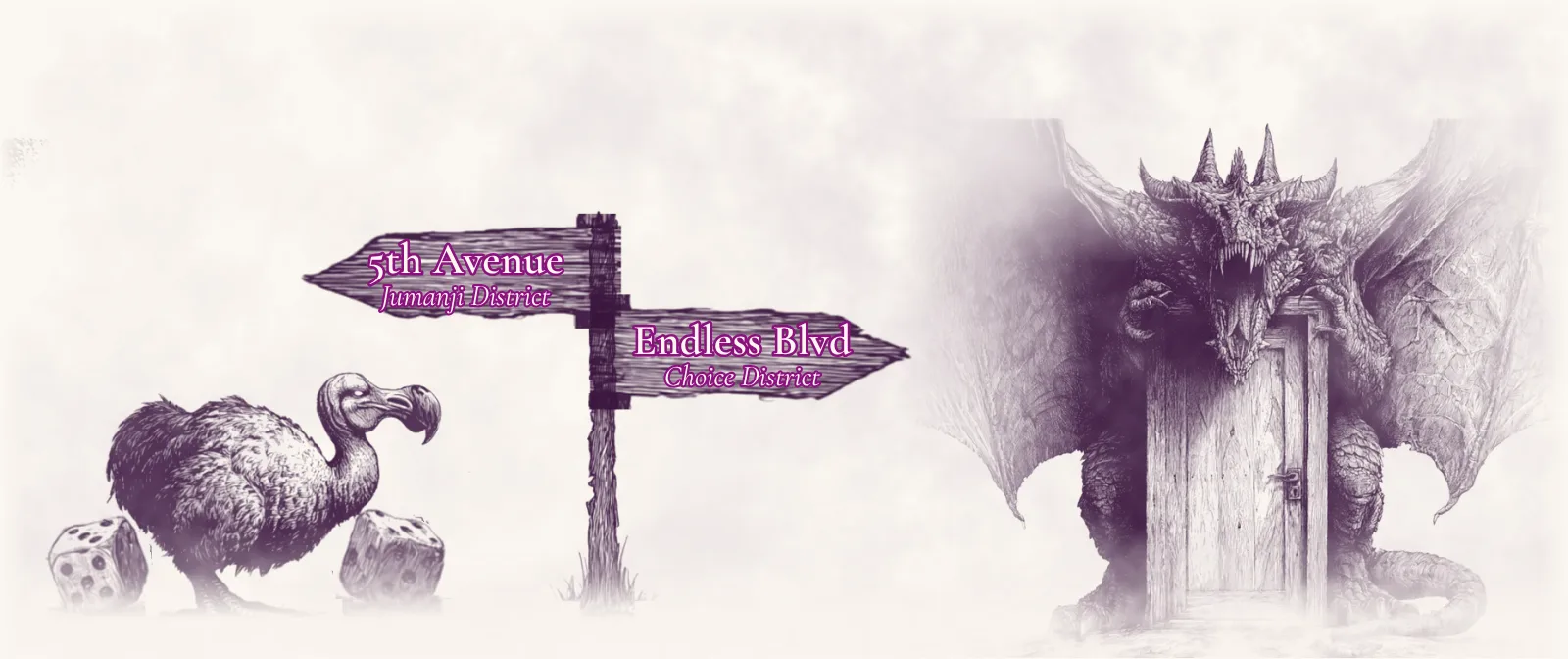
A signpost in the mist: 5th Avenue, Jumanji District points left toward a dodo and two battered dice; Endless Blvd, Choice District points right toward a closed door with a dragon looming behind it.

Nothing in that thread yet.

When you are ready

If any of this sounded like you, the Seen & Heard Welcome Conversation is one full hour and costs nothing.

See the open times

← Back to the beginning  ·  The programs →  ·  Questions people ask →

Registered freelancer · Freelance Certificate FL-884847149 · Ministry of Human Resources and Social Development · verify at freelance.sa

Instagram: @kmseenheard  ·  LinkedIn: khlood-alsharif  ·  TikTok: @kmseenheard  ·  Snapchat: kmseenheard  ·  WhatsApp: +966 54 248 6027